

The Science of Klinrisk
Diagnosing chronic disease is not enough
To impact patient outcomes, we must move beyond diagnosis to risk stratification and treatment
Recent Publications & Posters
Klinrisk is built on a foundation of unmatched scientific leadership and evidence

Prognostic Enrichment using the Klinrisk Model: Insights from the CANVAS Program and CREDENCE trial
Presented at the 2024 American Society of Nephrology (ASN) meeting, this abstract explores the potential impact of extending clinical trial recruitment criteria to individuals with lower urine albumin-to-creatinine ratio (ACR) who are classified as high-risk with the Klinrisk model. This prognostic enrichment has the potential to accelerate drug development and allow for more inclusive and efficient clinical trials.

Baseline Characteristics and Early Results from the GEMINI-RAPA Project: Improving the quality of CKD care with risk prediction and personalized recommendations
Presented at the 2024 National Kidney Foundation (NKF) meeting, as well as an abstract at the 2024 American Society of Nephrology (ASN) meeting, the preliminary results of the GEMINI-RAPA project outline the baseline characteristics and early outcomes observed in 5 large US nephrology practices that are currently implementing the Klinrisk model with personalized clinical recommendations, demonstrating marked improvement in quality-of-care indicators.

Machine learning for prediction of chronic kidney disease progression: Validation of the Klinrisk model in the CANVAS and CREDENCE trial
Published in Diabetes, Obesity, and Metabolism, this study details the results of an external validation of the Klinrisk model in the CANVAS and CREDENCE clinical trials for the sodium-glucose cotransporter 2 (SGLT2) inhibitor canagliflozin across 24 countries in patients with type 2 diabetes and high cardiovascular risk (CANVAS), or patients with type 2 diabetes and elevated albuminuria (CREDENCE).

Implementing a Machine Learning Model to Predict Risk of Chronic Kidney Disease (CKD) progression
Presented at the 2024 American Diabetes Association (ADA) meeting as an oral abstract, this presentation provides the results of an external validation of the Klinrisk machine learning model in over 1 million patients with CKD from the Optum electronic health records database, which covers over 115 million unique lives in the United States.

A risk-based approach to clinical trial recruitment using the Klinrisk algorithm: Insights from the CANVAS Program and CREDENCE Trial
Presented at the 2023 Global Cardiovascular Clinical Trialists (CVCT) Workshop, this abstract presents novel clinical trial recruitment strategies where trials that currently have a high recruitment threshold for urine albumin-to-creatinine ratio (ACR > 300mg/g) could be extended to patients with lower urine ACR (30 – 300 mg/g) and high risk of progression with the Klinrisk model without impacting event rates.

External Validation of the Klinrisk Model in US Commercial, Medicare Advantage, and Medicaid Populations
Presented at the 2023 American Society of Nephrology (ASN) meeting as an oral abstract, this presentation provides the results of an external validation of the Klinrisk machine learning model in over 4 million patients across US commercial, Medicare, and Medicaid patients.

Practical Utilization of Prediction Equations in Chronic Kidney Disease
This review article published in Blood Purification provides an overview of existing prediction equations for the prognosis and management of CKD, with a focus on how these models can be integrated in the clinical setting, as well as how they align with current CKD management guidelines for early- and late- stage disease management.

Development and Validation of a Machine Learning Model for Progression of CKD
Published in Kidney International Reports, this study details the results of the development of the Klinrisk machine learning model and its first external validation. Initially developed in over 70,000 patients and subsequently validated in over 100,000, the Klinrisk model was found to be highly accurate and well calibrated for the prediction of kidney disease progression.

Artificial Intelligence in the Identification, Management, and Follow-Up of CKD
This review article published in Kidney360 details challenges in the screening, identification, and treatment of patients with CKD, providing the context of how existing and new artificial intelligence solutions can be applied to address existing gaps.

KDIGO 2024 Clinical Practice Guideline for the Evaluation and Management of Chronic Kidney Disease
Included as a practice point (2.2.4) in the 2024 KDIGO clinical practice guidelines for managing CKD, the Klinrisk model is provided as one of the externally validated risk models for prediction progression of CKD (40% decline in eGFR).
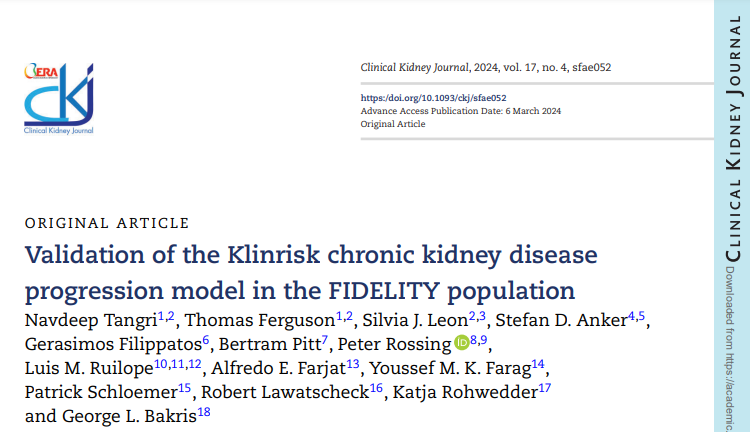
Validation of the Klinrisk chronic kidney disease progression model in the FIDELITY population
Published in Clinical Kidney Journal, this study describes the results of an external validation of the Klinrisk model in the FIDELIO-DKD and FIAGRO-DKD (FIDELITY) clinical trials which evaluated the non-steroidal mineralocorticoid receptor agonist (MRA) finerenone among patients with CKD and type 2 diabetes.